

Outperformance of the USA
The S&P 500 has enjoyed a stellar decade of growth, compounding at 12% in US dollars. In comparison, the MSCI ACWI (All Country World Index), excluding the USA, has compounded at only 5% over the same period. The dominance of the US market is evident in the top 10 constituents in MSCI ACWI, all of which are American companies, and they now make up 65% of the MSCI ACWI. Given this, it is crucial for investors to assess whether US stocks are justifiably expensive or if valuation concerns are overstated.
For years, the consensus has been that the US market is expensive, consistently trading at a premium on various valuation metrics such as price/earnings, price/sales, dividend yield, and price/book. However, such a conclusion may be overly simplistic.

The USA’s growth and return advantage
US companies have delivered stronger earnings growth than other geographies. This has been driven by a combination of easy monetary and fiscal conditions, healthy demographics, a venture capital industry, and a regulatory environment that fosters entrepreneurial innovation.
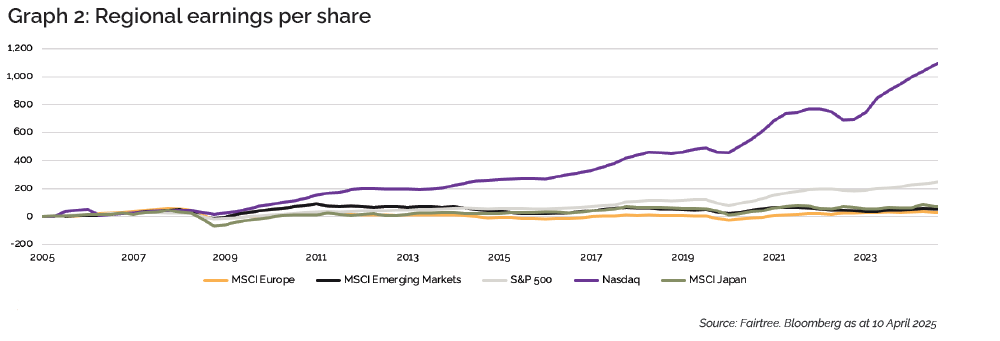
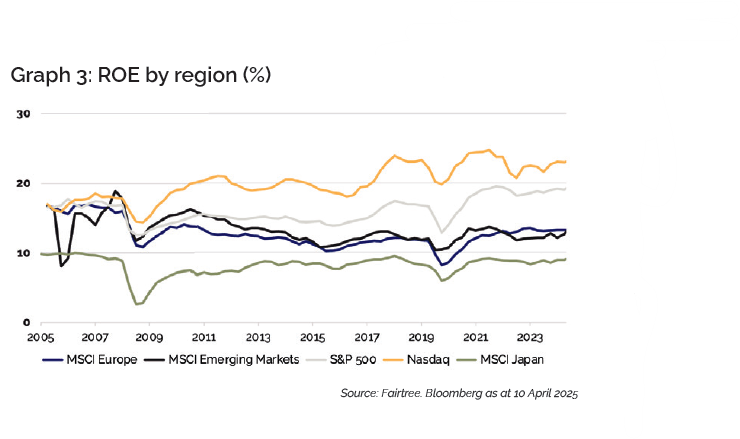
US companies have consistently delivered superior returns compared to their developed market peers, benefiting from higher profitability and better capital efficiency. While European and Japanese firms often struggle with sluggish economic growth and structural inefficiencies, US corporations have leveraged technology, innovation and flexible labour markets to sustain higher margins and shareholder returns.

The cost of capital has changed
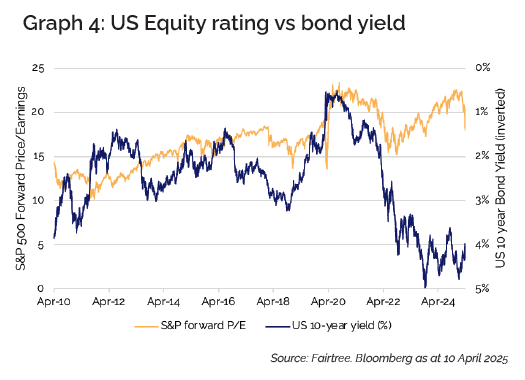
When the cost of capital was cheap during the early 2010s, it allowed companies such as Meta to purchase businesses like Instagram and WhatsApp, thereby strengthening their eco-system and deepening their moats and enhancing their advertising monetisation potential. In this low-rate environment, investors could justify paying higher multiples for these high-growth companies. One of the biggest shifts over the last few years has been the increase in US bond yields. With US inflation remaining sticky and bond yields above 4%, the cost of capital has increased, making equities less attractive relative to bonds versus the previous decade.
One of the biggest shifts over the last few years has been the increase in US bond yields
Investors must also weigh valuation multiples against a broader set of fundamental factors, including growth prospects, return profiles, changing capital intensity, and sustainability of competitive advantages in a fast changing environment.
The BATMMAAN effect
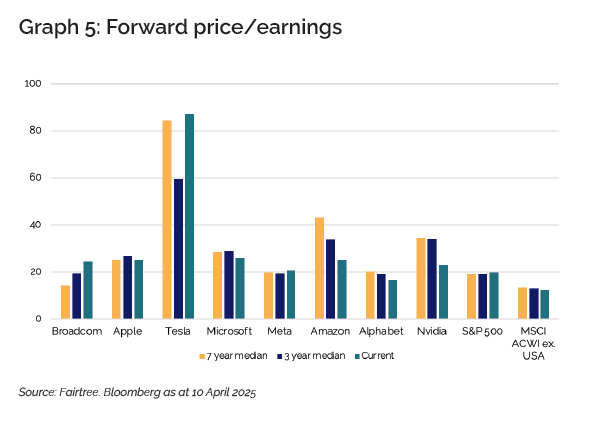
A significant portion of the US market’s strength comes from a handful of dominant technology companies, often referred to as the BATMMAAN stocks Broadcom, Apple, Tesla, Microsoft, Meta, Amazon, Alphabet, and Nvidia. These companies have reshaped industries, with their high-margin, capital-light business models enabling them to generate substantial cash flows and reinvest in growth. Unlike traditional sectors such as Financials, Materials, and Industrials, which require continuous reinvestment, these tech giants enjoy pricing power, network effects, and recurring revenue streams, justifying their premium valuations. Interestingly, history shows that dominant companies tend to remain dominant for longer than many investors expect. Despite their superior business models and growth outlook, most of these companies have derated over the last couple of years and now trade at parity versus the S&P 500.
Conclusion Closing Thoughts
While the US stock market may appear expensive on a headline basis, its premium valuation is backed by structural advantages, superior earnings growth and returns, and sector composition differences. The rise of the BATMMAAN companies has further reinforced this trend. As history has shown, valuation alone is rarely a sufficient reason to avoid an investment— growth, quality and competitive advantages must also be factored into the equation. Investors should, therefore, tread carefully before dismissing the US market as merely "too expensive". Rising uncertainty from tariffs and broader geopolitical tensions, as well as the fast-changing technological landscape, means that multiples will probably compress and that you must be selective with your exposure.