
Counterbalance of exchange rate and equity markets
The South African rand is one of the most volatile currencies globally compared to advanced economies and emerging market peers. Only the Russian rouble and Argentinian peso have been more volatile in the last decade. South Africa’s rand is traded in large volumes globally and is often used as a proxy for emerging market investment. It makes the currency highly exposed to external shocks and, thus, highly volatile.
It is in most people’s best interests to diversify and invest in offshore equities, but trying to time the investment can be very nerve-wracking, especially if you’re advising clients or making investment decisions on their behalf. What if the rand strengthens and the investment loses value in rand terms?
The good news is that if you look at the last 25 years, it is rare for the exchange rate movement to dominate equity returns.
Equities and emerging market currencies, like the rand, are assets that perform well in risk-on environments. It is, therefore, unusual for the rand to strengthen when global equities sell-off.
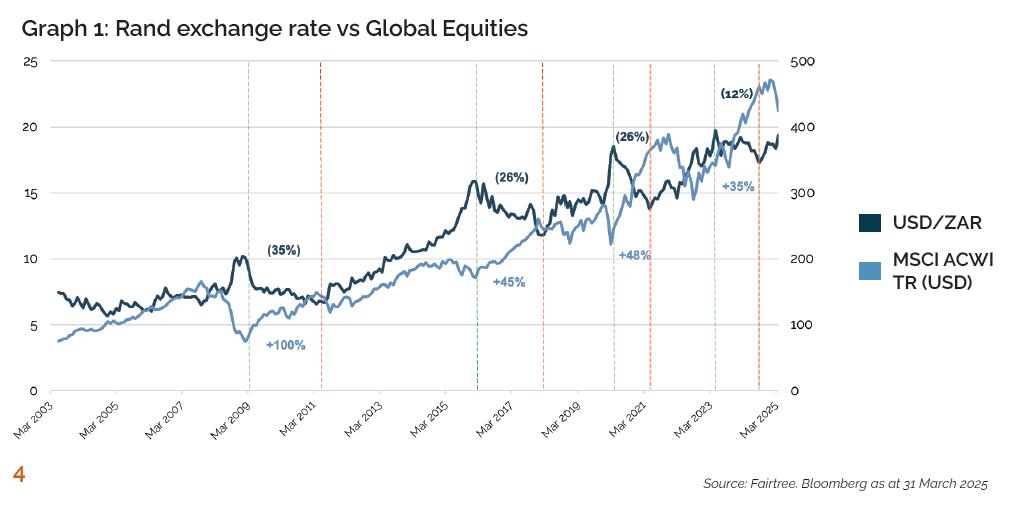
If you were unlucky or panicked at the four points in the last two decades (green dotted lines in Graph 1 below) where the rand was extremely undervalued, you still ended with a positive return in rand terms on all four occasions. The rand strengthened by 12-35% over these four periods, while global equities rallied 35-100%.
The rand strengthened by 12-35% over these four periods, while global equities rallied 35-100%.
Looking at the opportunity cost
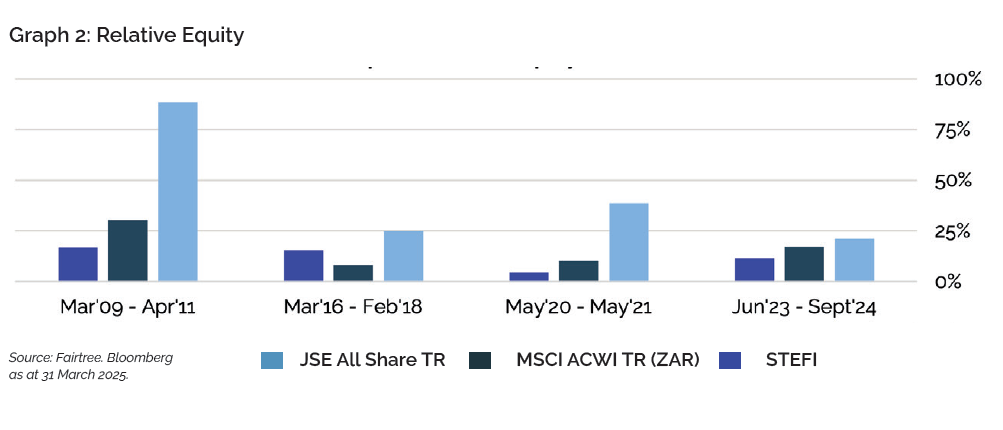
Clearly, investing offshore before the rand strengthens by more than 10% is not optimal, but hardly a disaster. You need to consider the alternative if you are trying to time the exchange rate. Do you wait in a money market account, which generally offers a low real return, or will you deploy the money in local equities? The offshore equity investment outperformed STeFI in three of the four periods despite the rand strengthening significantly. Investing in the local equity market would have been a better decision over all four periods, but investing in equities with such a short time horizon is usually not advisable.
The South African Rand is undervalued
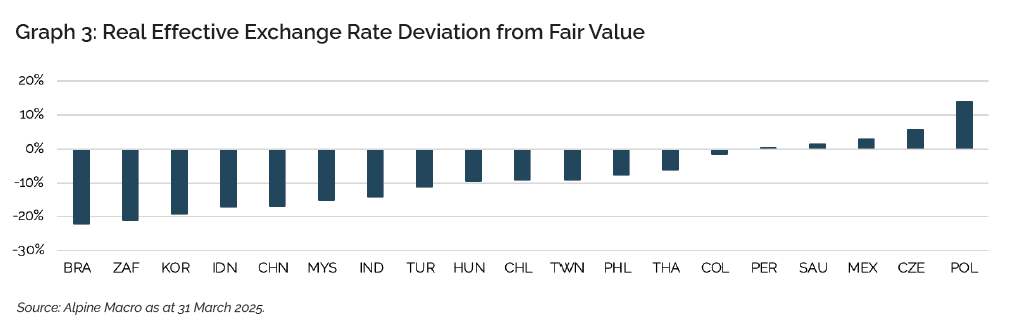
The rand almost always appears undervalued, irrespective of your preferred calculation method. Unfortunately, with the lack of sufficient electricity supply, logistics capacity, and other regulatory constraints, our economy struggles to react to exploit this rand weakness by ramping up production for exports.Looking at South Africa’s rising debt/GDP and debt service costs, our fiscal situation remains precarious and therefore attracts an extra risk premium.
CONCLUSION: Closing thoughts
The rand is undervalued above R18.50, but no clear catalysts are on the horizon for it to strengthen significantly. It is difficult to time equity markets and exchange rates, so it is often best to stick to your strategic asset allocation unless we are at extreme levels. If that requires you to invest in offshore equities, it probably does not help to worry too much about getting the optimal rand exchange exit point because it could mean you are missing out on valuable equity returns.